
Behind the Scenes: How Trump’s Midnight CEO Call Cut Into His Summit With Xi
By inviting America’s top executives into the room, Trump sacrificed precious minutes with Xi — trading substance for spectacle.

Diplomatic summits are remembered for their grandeur: red carpets, military bands, and the symbolism of two flags side by side. The May 14–15 meetings between U.S. President Donald Trump and Chinese President Xi Jinping in Beijing were no exception.
Children waved banners, cameras flashed, and the choreography of statecraft was on full display. Yet behind the optics, the substance of the summit was more constrained than many realized.
Trump’s May visit to Beijing was already a compressed one. Originally slated for April, the trip was postponed due to the Iran crisis and shortened from two full days to barely a day and a half. Beijing had even floated the idea of a Shanghai stopover, a chance for Trump to see China’s answer to New York. Eventually, the itinerary was narrowed to Beijing alone: a full day of ceremonies and talks on May 14, followed by a half‑day on May 15, including a private meeting inside Zhongnanhai, Xi’s workplace and residence.
For Xi, the summit was meant to showcase the “Diplomacy of Head of State (元首外交),” a concept emphasized since the last Trump–Xi encounter in Busan, South Korea last October.
This time the agenda for Xi-Trump summit was supposed to be very long: Taiwan, Iran, Boeing and GE contracts, fentanyl, Nvidia’s chip exports, and more. Chinese officials had planned at least two and a half hours of structured dialogue on Day 1 to work through this list. But Trump, true to form, upended the script.
According to sources involved in the summit, Trump arrived in Beijing on May 13 evening and, instead of resting after his long flight, summoned the CEOs traveling with him to join the next morning’s meeting with Xi.
The request, made almost at midnight after Trump checked in his residence in Beijing, Four Season Hotel at the heart of China’s business district and near U.S. Embassy in Beijing, forced executives to scrap their own schedules.
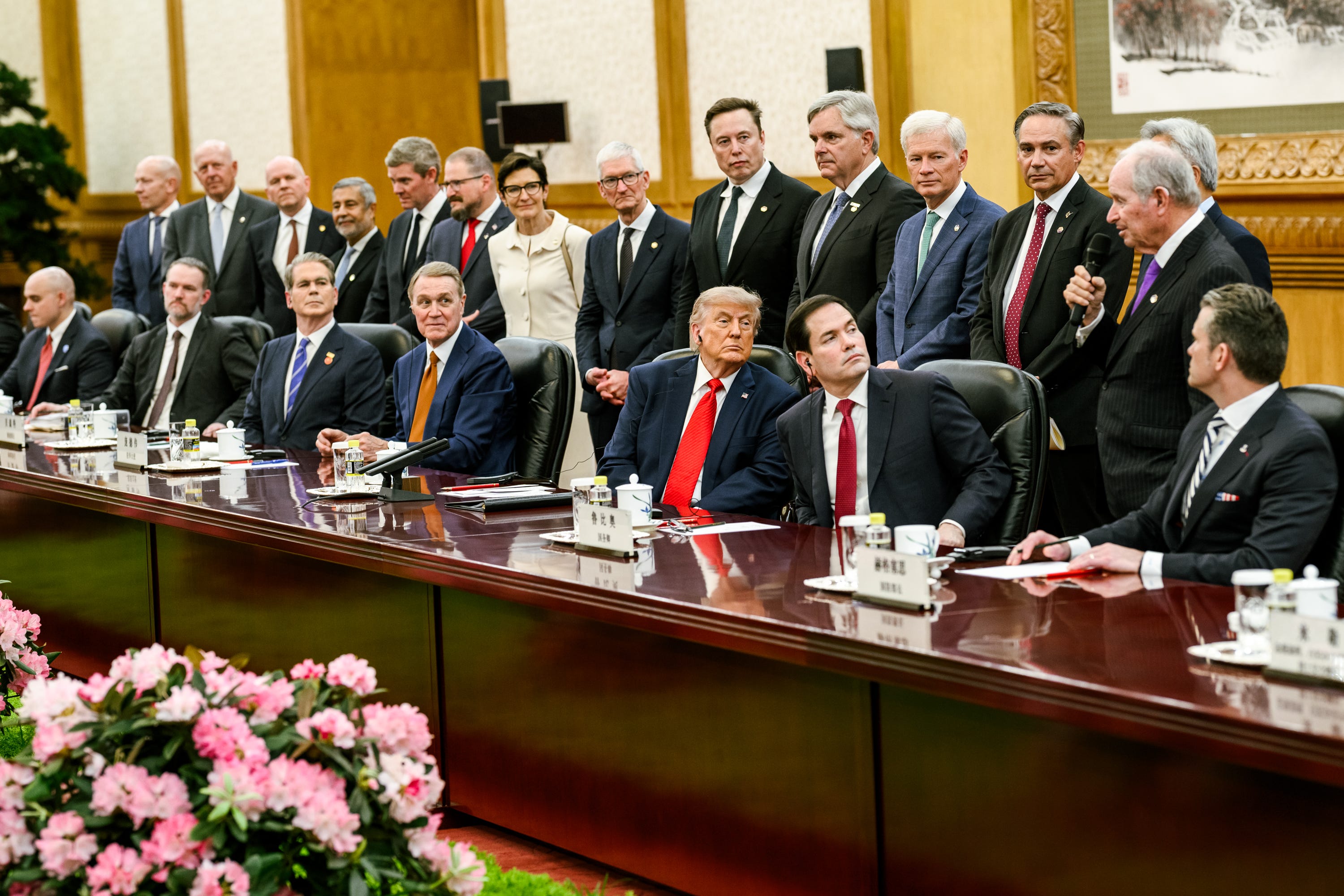
On May 14, seventeen top American corporate leaders stood behind Trump and his cabinet at the Great Hall of the People. Each was asked to introduce themselves for one to two minutes. The exercise consumed nearly half an hour — time originally reserved for substantive negotiation. The optics were striking: the U.S. side appeared larger, more imposing, a tableau of “Corporate America” aligned with Washington. But the trade‑off was clear. Every minute spent on introductions was a minute lost for diplomacy.
For the CEOs, the cameo was hardly effective. Given time constraint, none of them really had the opportunity to spell out their company’s specific challenges in front of Xi — and many preferred to keep sensitive issues confidential anyway. Several executives, including those from Citi and Visa, chose to remain in Beijing after Trump’s departure on May 15 to pursue closed‑door one‑on‑one meetings with Chinese ministers. In those private settings, they could detail their concerns more fully and discreetly.
Trump may have tried to showcase his corporate entourage, but for the CEOs themselves, the exercise felt neither efficient nor substantive.
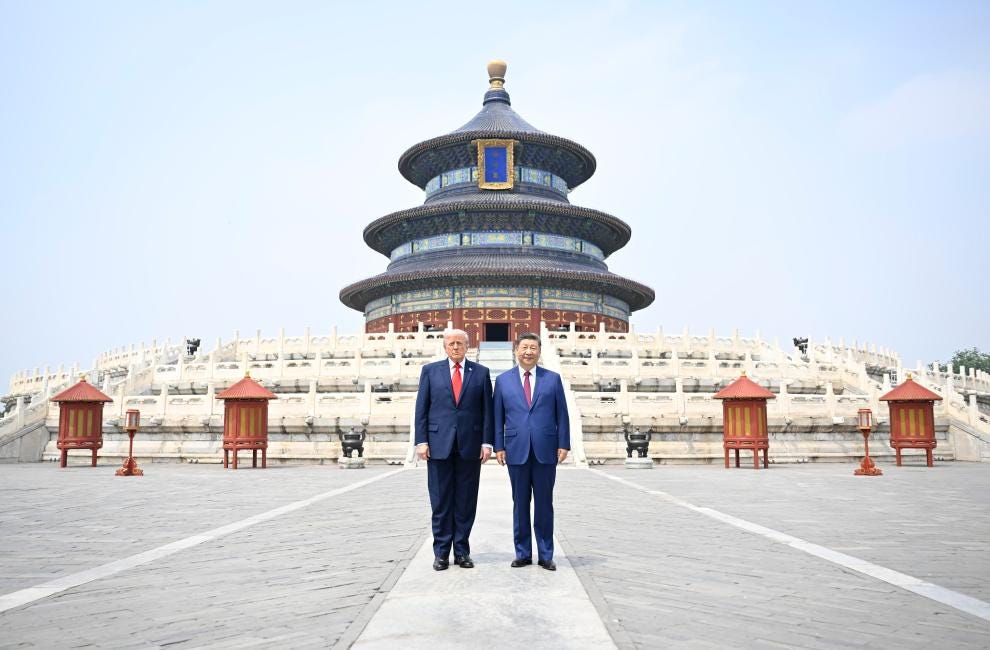
The rest of the summit followed the ceremonial script. Trump and Xi toured the Temple of Heaven, producing photographs that dominated front pages worldwide. On Day 2, Xi hosted Trump inside Zhongnanhai, offering a private tour and one‑on‑one conversation.
Trump later told U.S. media that Xi used that one-on-one time to press Taiwan — Beijing’s “first uncrossable red line.” Other issues, from Nvidia’s H200 exports to rare earths and AI cooperation, were left largely untouched.
This behind‑the‑scenes detail underscores a broader truth about modern summitry: leaders are constrained not only by geopolitics but by performance. In Beijing, the cameras captured grandeur, but the clock told another story.
Two hours of talks became less than two hours of substance, and the balance tilted toward optics over outcomes.
Still, the summit was not without consequence. Days later, China’s foreign ministry announced a new bilateral dialogue on AI cooperation, focused on governance, safety, and security.
Before Trump returned to Washington, D.C., he publicly invited Xi to the White House on September 24, timed to coincide with Xi’s expected appearance at the UN General Assembly. Additional encounters loom at APEC in Shenzhen in November and the G20 in Miami in December. The “Diplomacy of Head of State” is only beginning.
For American CEOs, the lesson is clear. In Trump’s Washington, the president sets the stage — sometimes literally.
As Nvidia’s Jensen Huang quipped, when the president calls at midnight to join him on Air Force One, “you take the order and get on the plane.” In Beijing, that culture of “yes, sir” reshaped a summit, turning what was meant to be a strategic dialogue into a showcase of corporate muscle.
The symbolism was powerful. The substance, less so.