
From Missing Name to Main Character: Nvidia’s Jensen Huang Stole the China Trip Spotlight
A last‑minute phone call from the President turned Nvidia boss Jensen Huang from a missing name into the superstar of Trump’s China trip.

In Washington, D.C., the most interesting stories rarely unfold in front of cameras. They happen in the corridors, in hurried phone calls, in the awkward silences when senior staff disagree but no one wants to say the quiet part out loud.
In the last 24 hours leading up to President Donald Trump’s first state visit to China in his second term, one such story centered on a single name missing from the official delegation list: Jensen Huang, the black‑jacketed, leather‑clad CEO of Nvidia — the world’s most important AI‑chip designer.
At first, no one outside a tight circle noticed the omission. The White House had released a roster of American business leaders invited to join Trump on the trip — a mix of industrial giants, tech executives, and Wall Street dealmakers. But the man whose company had become the beating heart of the global AI race was nowhere to be found. On May 11 Nvidia’s PR team quietly confirmed to the media that Huang had, in fact, received no invitation from the White House.
Then President Trump himself noticed the growing media chatter about the “missing Jensen Huang.”
Why was Huang not invited in the first place?
It was understood that the White House had been deeply divided over whether Huang should join the delegation. Some of Trump’s more hawkish advisers argued firmly against inviting him. Their logic was blunt: if Beijing refused to approve the import of Nvidia’s H200 chips — a major flashpoint in U.S.–China tech competition — then having Huang on the trip could make Trump look weak.
“Why bring him if China might embarrass us?” was reportedly the sentiment among some advisers. Others worried that Huang’s presence could soften Trump’s negotiating posture at a delicate moment. Nvidia’s commercial interests in China are enormous; critics feared that optics alone could send the wrong message.
Trump’s interest in Huang didn’t come out of nowhere. Throughout 2025, Huang had been lobbying the administration to loosen AI‑chip export restrictions, arguing that cutting Nvidia off from China would ultimately weaken America’s own competitiveness. By January 2026, Trump publicly embraced Huang’s argument and announced that the U.S. would allow Nvidia to sell its H200 chips to “approved customers” in China — on the condition that 25% of all revenues go to the U.S. government, up from the earlier 15% revenue‑share arrangement for the lower‑end H20 chips.
But the approval turned out to be largely symbolic. China has not approved the import of a single H200 chip since the policy shift, with Beijing reportedly discouraging major tech firms — including Baidu, Tencent, and Alibaba — from buying foreign AI processors altogether. As a result, Nvidia’s H200 sales to China remain effectively zero, not because of U.S. restrictions, but because Beijing has not granted import clearance.
This dynamic fueled speculation that Trump might ask President Xi Jinping directly to approve H200 sales during the visit. From Beijing’s perspective, the calculus is complicated: China has not yet reached the point where domestic chips match the performance of Nvidia’s top‑tier processors, but it is racing to close the gap. The window for Nvidia to do business in China is open — but narrowing.
Compared with advisers who feared that Huang’s presence might weaken Trump’s “strongman” image, Trump — characteristically — had a different instinct. Nvidia was the most valuable semiconductor company in the world. Huang was a symbol of American technological dominance. And Trump, who appreciates a dramatic flourish, seemed to understand the power of having the AI king himself on Air Force One.
So on the morning of May 12, Trump picked up the phone.
Huang, who had not been expecting any such call, accepted immediately. The trip was happening. The plane was leaving. If he wanted to be part of it, he needed to move fast.
And he did.


Within hours, Huang boarded his private jet and raced toward a rendezvous point that felt almost cinematic: Alaska, where Air Force One would stop to refuel on its way to Beijing. It was the kind of scene you’d expect in a political thriller — a billionaire CEO flying across the continent to intercept the President’s plane on the edge of the Arctic Circle.
When Air Force One touched down, Huang climbed aboard.
When the mood shifted
Up until that moment, the business delegation had been a fairly balanced group. But the second Jensen Huang stepped onto the aircraft, he became — almost instantly — the most closely watched CEO on the plane. The symbolism was unmistakable: the man driving the global AI boom had just been hand‑picked by the President at the last minute.
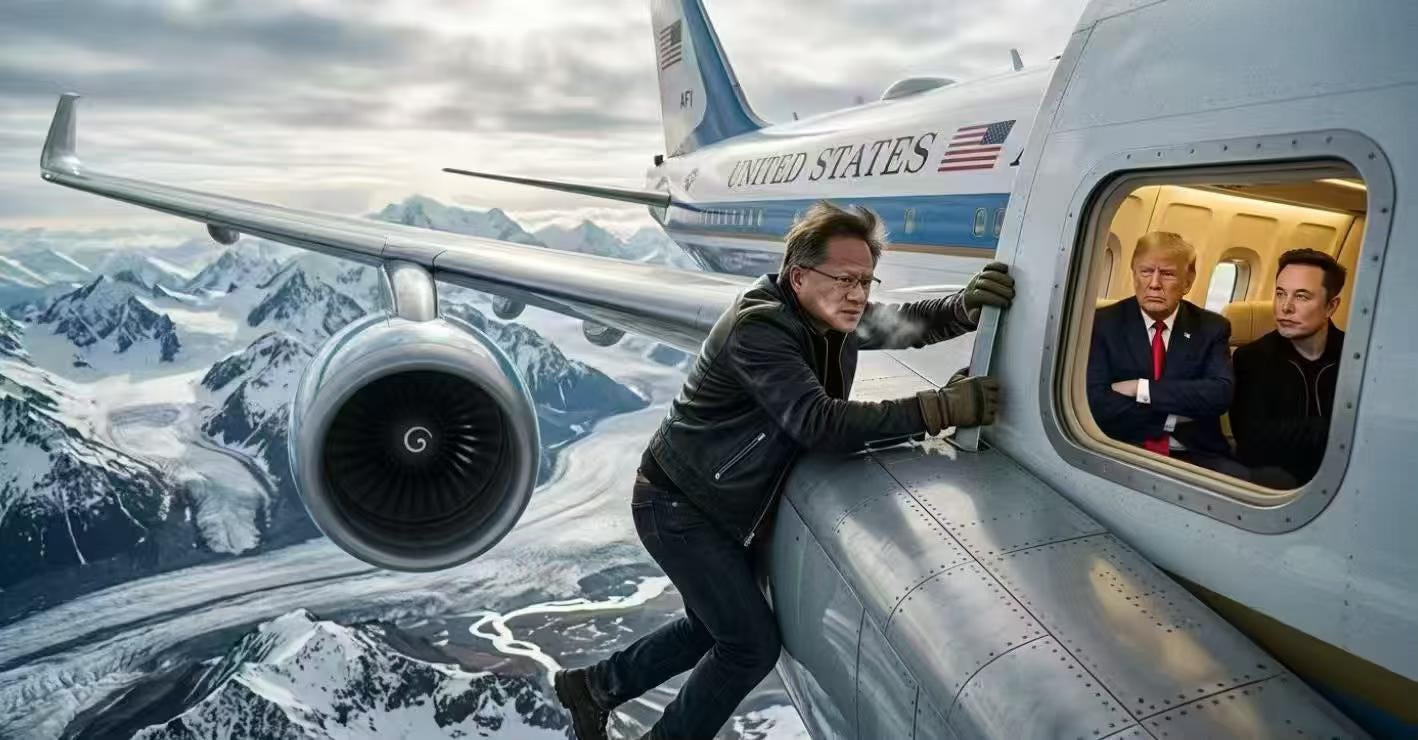
Global media blasted out alerts: “Jensen Huang joins Trump on Air Force One.” Social platforms erupted with AI‑generated memes of Huang sprinting toward the plane. And the stock market noticed too.
As news spread that Huang had joined the delegation — and that he had boarded Air Force One itself — Nvidia’s share price surged to record highs. Investors interpreted the moment as a signal: if Trump wanted Huang by his side in Beijing, Nvidia’s position in the U.S.–China tech equation was stronger than many had assumed.
Meanwhile, the political pressure on Huang in Washington is unlikely to fade anytime soon.
Inside the White House, hawkish advisers remained uneasy. Their earlier concerns hadn’t disappeared. What if Beijing refused to budge on chip approvals? What if Huang’s presence complicated negotiations? What if the optics backfired?
On Capitol Hill, Huang’s reputation was also mixed. Some lawmakers viewed his push for H200 sales to China — aligning with Beijing’s calls for fewer U.S. tech restrictions — as a national‑security risk. A few even privately described Huang as “unpatriotic.” The political pressure was real.
Just weeks before Trump’s trip, Congress introduced the MATCH Act — the Maintaining American Technology Competitiveness and Homeland Security Act. Though not yet passed into law, the bill signaled a bipartisan appetite for tougher guardrails on China’s access to advanced U.S. technologies. MATCH would expand federal authority over outbound investment, tighten export controls on high‑end semiconductors and AI systems, and require U.S. companies to disclose or seek approval for certain tech‑related activities in China.
The timing was unmistakable: as Trump prepared for a high‑stakes diplomatic visit, Congress was moving in the opposite direction — toward even stricter limits.
For Huang, the stakes were enormous. Nvidia’s future in China — and China’s future in AI — are deeply intertwined. Beijing’s demand for advanced chips is insatiable. Washington’s export controls are tightening. And Nvidia sits at the center of this geopolitical tug‑of‑war. Being physically present on the trip gave Huang a seat at the table during one of the most consequential diplomatic moments of the year.
For Trump, the move was classic: bold, unexpected, and designed to shift the narrative. Instead of a story about internal divisions or hawkish caution, the headlines became about the President personally calling the world’s most important chipmaker and bringing him onto Air Force One at the last minute. It was a flex — and Trump knows a good flex when he sees one.
By the time the plane crossed the Pacific, the story had already taken on a life of its own. A missing name on a list had turned into a presidential phone call, a private‑jet dash to Alaska, and a sudden reshuffling of power dynamics at 35,000 feet.
And that’s Washington: the most important decisions are often made not in conference rooms, but in moments of instinct — a headline, a question, a phone call.
Jensen Huang wasn’t supposed to be on that plane.
But he was.
And in the end, he became the most important CEO on it.
Nvidia's ability to make chips is about to fall into a bomb crater sized hole. By the time it struggles out, the world's AIs will be running on Beijing branded chips, maybe testing lower in labs, but running AIs cheaper and more plentiful than what runs on NVIDIA chips.