
Robotics Chasing EVs to Become a Focus of the U.S.-China Tech Race
Scale has proven essential for R&D, adoption, and global market reach.

As China and the United States lock in for a rapidly expanding race for advanced Artificial Intelligence (AI) developments, a new battlefield for high-technology consumer products is already emerging in commercial robotics.
This follows the massive success of China’s electric vehicle (EV) industry led by market leaders such as BYD, Nio, and Xpeng. BYD alone already has three models that are bestsellers in the global market.
Even before the release of the classic 1984 movie Terminator, in which the killer ominously pledged “I’ll be back,” robots have captured the imagination of U.S. and Chinese consumers. In 2022, Elon Musk’s big reveal of Optimus, also known as the Tesla Bot, made people realize modern robots were no longer just science fiction — they are entering our daily lives at a more affordable price level than ever before.
Musk’s robotics ambitions have expanded in parallel with Tesla’s global ascent. Throughout the process, China has become a central manufacturing hub that produces over half of the company’s vehicles each year. Much like Tesla’s ongoing competition with China’s homegrown BYD in the highly competitive EV market, Musk now faces a new challenge from China in the field of advanced robotics.
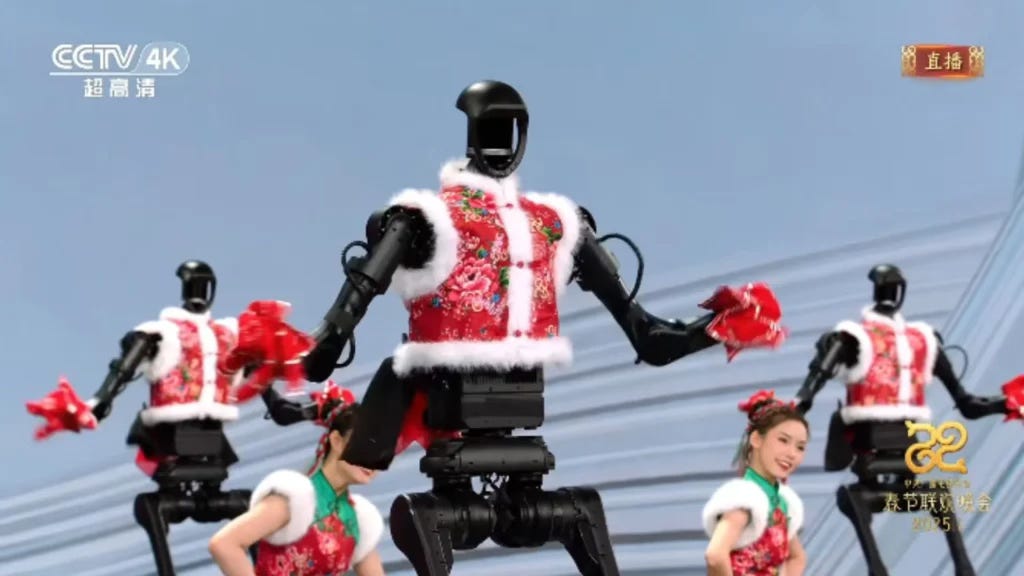
Wang Xingxing, founder and CEO of Unitree Robotics, revealed new details about his company during the 2025 Summer Davos forum in Tianjin. Headquartered in tech-crazy Hangzhou, Unitree first gained national attention when dozens of its robots performed a sophisticated dance during an annual Lunar New Year gala.
Wang shared that the company has now reached an annual revenue of approximately USD 140 million. Unitree has also grown to over 1,000 employees — a major leap from its founding in 2016, when Wang was its sole staffer.
Unitree is not Tesla Bot’s only competitor in China. Tesla’s erstwhile EV rivals, including BYD and Xiaomi, have announced plans to enter the robotics business as well. The AI technologies behind EV design processes, particularly autonomous systems, can be readily adapted for modern robotics design. Existing EV supply chains and manufacturing lines can also be leveraged for mass robot production, giving Chinese EV companies a strong competitive edge from the start.
Globally, BYD now makes three of the bestselling vehicle models by market share. It would not be surprising if Chinese firms such as Unitree soon secure several top positions in global robotics sales. Unitree’s robots are priced at approximately one-third the cost of Tesla’s Optimus, which is currently available for around USD 30,000.
In China’s nascent robotics market, there are already a dozen robot startups like Unitree. By 2026, industry analysts predict domestic sales of modern robots may soon hit USD 3 billion in annual revenue, with Chinese households driving demand for domestic help and security products.
Many middle-class families in China have already purchased an EV as their second car. If Unitree can keep the asking price for its popular robot model G1 under USD 10,000 more affordable than EVs, the domestic robot market could see significant growth. In this scenario, Chinese startups like Unitree may surpass Tesla and several European brands in the robotics race in terms of scale.
Also in the AI race, scale has already proven essential for R&D, adoption, and global market reach.
As the Trump administration re-authorized sales of Nvidia’s advanced H20 chips — used to train frontier AI models — to China, the flow of advanced technologies and EV complements to the robotics sector will accelerate. Global consumers may soon become familiar with a wider range of Chinese technology brands beyond household names like Huawei and BYD, particularly in European and Southeast Asian markets.
These rapid advances align with President Xi Jinping’s vision of technological “self-reliance” as China emerges as the only country capable of producing domestic alternatives to nearly all major U.S. tech products. Examples include BYD vs. Tesla, Huawei vs. Apple, and DeepSeek vs. OpenAI and Google’s Gemini.
With Unitree now challenging Tesla Bot and its peer Boston Dynamics, which focuses more on scientific research than the consumer market, the list is growing — marking the beginning of a new technological contest between the world’s two largest economies.